01
Original concept · preserved
The lab design
The original design pack records the starting proposal. Use it to explain how the idea evolved.
Open original design pack PDF ↗DESIGN COLLECTION / PRESENTATION START
Follow the project from its original lab concept to a five-person rest pavilion. Open each model, select its components, and explain what they do and why they are placed there.
Presentation and digital design package. These are concept designs and software demonstrations. No physical prototype, measured cooling performance, structural approval or manufacturing certification is claimed.
Read the design defense: every decision, the physics, costs and panel questions
Original concept · preserved
The original design pack records the starting proposal. Use it to explain how the idea evolved.
Open original design pack PDF ↗Tabletop · fabrication candidate
Explore the compact enclosure and component arrangement. The local API and firmware support bench development; physical assembly and validation remain separate.
Rotate / explode the tabletop model ↗Explore simulated experiments ↗Physical test protocol ↗FS-01 · engineering concept
The earlier full-size structure, component placement and engineering review package. Its cost estimates do not apply to the larger FS-02 pavilion.
Engineering review and downloads ↗Download FS-01 review package ↓FS-01 · illustrative operation
Recognizable fans, sensors and a reference worker show the proposed airflow path. Click components and explore synthetic operating conditions; animations are not CFD.
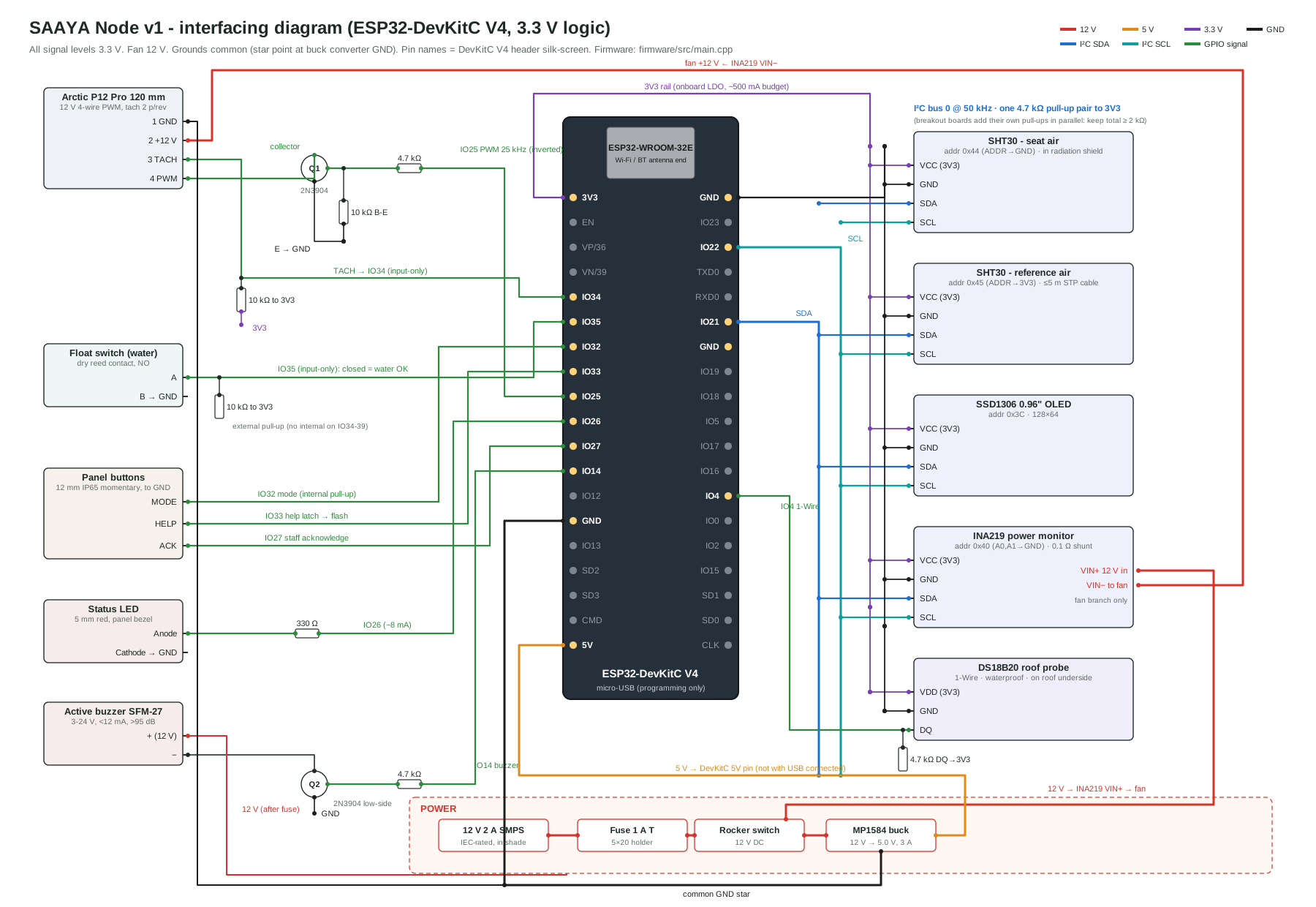
Open worker cooling / interactive CAD ↗Open clickable IoT architecture and placement guide ↗SAAYA Node v1 · retrofit IoT product
A ₹5k-class controller that bolts onto any existing rest shade: ESP32, shielded air sensors, roof probe, power monitor, PWM fan, help button. Full pin diagram, specifications, dimensioned 3D model and deployment plan.
Open the IoT design document (PDF) ↗Rotate the 3D model ↗Interfacing diagram ↗Download STEP ↓Project report · VIT format
The full A4 project report: problem, shelter design and heat model, IoT system with component selection and compatibility, interfacing diagram, 3D models, deployment, cost, verification plan and limitations.
Open the project report (PDF) ↗Concise 7-page version (PDF) ↗Hardware simulation · runs the firmware’s rules
Every part of the SAAYA Node wired as built: ESP32, two SHT30, DS18B20, INA219, OLED, 4-wire fan, buttons, LED, buzzer and float switch. Change the heat, press HELP, stall the fan or cut the power and watch the firmware react. A complete Wokwi project runs the real firmware on an emulated ESP32.
Open the hardware simulator ↗Wokwi project (zip) ↓FS-02 · new five-person concept
Five reclining cots, five individual fans, local sensor/control positions, deep shade, jaali-inspired screens and a ventilated double roof. Inspect all 31 component groups.
Open five-person interactive CAD ↗Download assembly STEP ↓Download editable CAD source ↓Read design rationale and limitations ↗Explain the comparison honestly: a movable fan is cheaper. The pavilion adds shade and rest facilities; its added benefit must be measured. AI can explain evidence, but does not regulate blood pressure or determine worker safety.
Read passive-design rationale, comparisons and next validation steps ↗